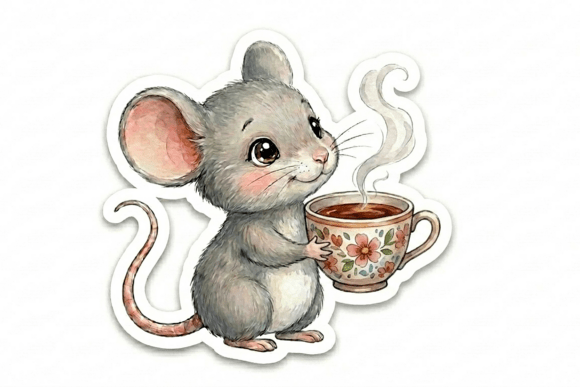
Cozy Mouse with Hot Tea Cup Sticker
Imagine opening your planner on a quiet Monday morning and placing a soft, watercolor-style mouse holding a steaming mug right beside your to-do list. It’s not just decoration—it’s a tiny pause button, a visual whisper that says, “You’re allowed to be gentle with yourself.” That’s the quiet magic of the Cozy Mouse with Hot Tea Cup Sticker: a hand-crafted, kawaii-inspired illustration designed for real life—not just aesthetics.
This isn’t a generic clipart mouse. It’s painted in muted blush pinks, warm taupe greys, and creamy off-whites—colors that sit comfortably next to fountain pen ink, washi tape, or matte laptop decals. The transparent PNG format means it drops cleanly onto any background: a pastel journal spread, a minimalist Notion dashboard, or even a printed workshop handout for students learning mindfulness techniques.
Where It Fits Into Your Daily Rhythm
People reach for the Cozy Mouse with Hot Tea Cup Sticker when they need warmth without words. A freelance graphic designer adds it to client mood boards as a subtle nod to “calm creativity.” A high school English teacher prints five copies to stick beside reading reflection prompts—students instantly recognize the vibe: thoughtful, unhurried, kind. A small-batch candle maker uses it on product tags for their “Chamomile & Quiet” line, reinforcing brand tone before customers even smell the wax.
It shows up in places where intention matters more than flash: the corner of a habit tracker (“Drank tea + paused for 3 breaths”), embedded in a Canva template for therapist-led journaling workshops, or layered into a digital scrapbook page documenting a slow weekend—no grand events, just toast, rain at the window, and a favorite mug.
Real Uses Across Real Roles
For planners & journalers: Stick it near weekly intentions—not as filler, but as an anchor. One user told us she places it beside her “energy check-in” box every Sunday. If the mouse is there, she asks: *Am I scheduling space for rest, or just filling time?*
For educators & counselors: Print it at 0.5" size and use it as a tactile cue during classroom calm-down corners. Laminated and glued to a popsicle stick, it becomes a nonverbal signal: “I need a quiet minute.” No explanation needed—just recognition.
For digital creators: Drop it into email newsletters as a visual break between dense paragraphs. In one case study, a productivity blogger saw a 12% increase in scroll depth after adding the Cozy Mouse beside a section titled “What to Do When Your Brain Feels Like Static.” Readers commented: “It made me stop and breathe.”
For small business owners: Use it on printable packaging inserts—not as branding, but as emotional texture. A local bakery tucks it into orders with lavender shortbread; customers photograph it alongside their cookies, extending organic reach. It works because it feels personal, not promotional.
Why the Watercolor Style Matters (Beyond Aesthetics)
Watercolor isn’t just “cute.” Its soft edges and subtle pigment bleed mimic how humans actually experience comfort: gently, unevenly, with room for imperfection. Unlike sharp vector icons, this mouse doesn’t demand attention—it invites presence. That quality translates directly to usability: it won’t clash with handwritten notes, textured paper, or busy digital interfaces. It recedes just enough to support, never compete.
And because it’s delivered as a high-resolution PNG with true transparency, you avoid the jagged halos or fuzzy edges that ruin print projects or make digital layers look amateurish. One educator tested three versions of the same sticker across platforms—only this one stayed crisp when scaled down to 18px in a Google Slides presentation for fifth graders.
Things to Consider Before You Use It
First—match the tone, not just the theme. This sticker carries emotional weight. Placing it beside a harsh deadline reminder or a “URGENT” banner dilutes its effect. It lands best where gentleness is part of the message: self-care logs, gratitude journals, wellness challenge trackers, or invitations to low-pressure community events.
Second—check your file workflow. If you’re using it in Procreate or Affinity Designer, the transparent background works flawlessly. But if you’re pasting into older versions of Microsoft Word or Pages, test first: some programs auto-add white padding. A quick “save as PNG” after import usually fixes it.
Third—think about scale in context. At 300 dpi, it prints beautifully at 2–3 inches—but shrink it below 0.75", and the delicate whiskers and steam curl blur. For digital dashboards, 48–64px width maintains clarity without overwhelming text. Keep a resized version handy for those moments.
Who Benefits Most—and How
Hobbyists love it because it requires zero design skill—just drag, drop, and feel the lift. No color-matching stress. No “does this fit my aesthetic?” second-guessing. It’s ready-made warmth.
Freelancers and solopreneurs use it to humanize client-facing materials. A web developer added it to her proposal PDF footer—“Built with care, served with tea”—and clients consistently mention it in feedback. It signals competence *and* kindness in one glance.
Educators and therapists rely on its universal readability. Kids name the emotion before being asked (“She looks cozy”). Teens use it in art therapy collages to represent safety. Adults in burnout recovery place it on their phone lock screen—not as motivation, but as permission.
Content creators find it especially useful for breaking up algorithm-heavy feeds. On Instagram carousels about boundary-setting, it appears on slide 3—not explaining, just grounding. Followers report pausing longer there, which boosts engagement metrics organically.
The Cozy Mouse with Hot Tea Cup Sticker doesn’t solve problems. It holds space beside them. It’s the difference between saying “take care” and handing someone a warm mug with both hands. And in a world that rewards speed over stillness, that small, watercolor pause might be exactly what your next project—or your next hour—needs.