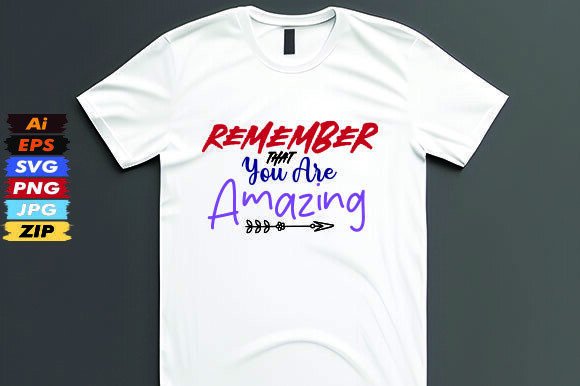
Remember That You Are Amazing: A Versatile, Professionally Crafted Design Resource for Everyday Expression
Design isn’t just about aesthetics—it’s a conduit for meaning, identity, and emotional resonance. At the heart of many thoughtful creative projects lies a simple yet profoundly human phrase: Remember That You Are Amazing. This statement transcends motivational cliché when translated into intentional visual form. It becomes a tool—flexible, scalable, and deeply adaptable—for individuals and organizations seeking to affirm value, foster inclusion, and communicate compassion through tangible media.
Why This Phrase Resonates Across Diverse Contexts
The power of Remember That You Are Amazing lies in its universality and quiet authority. Unlike prescriptive slogans or time-bound trends, it operates without conditions. It doesn’t demand achievement, conformity, or performance—it affirms inherent worth. Educators print it on classroom posters to reinforce growth mindset culture. Mental health practitioners integrate it into therapeutic workbooks and waiting room displays. Small business owners apply it to reusable shopping bags as a subtle act of community care. Even researchers studying self-efficacy in adolescent populations have observed how such affirming language, when paired with clean, accessible design, lowers psychological barriers to engagement.
This broad relevance is not accidental. The phrase meets key criteria for effective communication: brevity (five words), phonetic clarity (strong vowel-consonant rhythm), and semantic openness (it invites personal interpretation without ambiguity). When rendered in thoughtful typography and balanced composition, it becomes more than text—it becomes an artifact of intention.
What Makes the Design File Package Uniquely Practical
The Remember That You Are Amazing design package delivers professional-grade assets—not placeholder graphics or low-resolution previews—but production-ready files engineered for real-world use. Each format serves a distinct functional role:
- High-Quality JPG: Ideal for quick digital sharing, social media posts, email headers, or internal presentations where editing isn’t required but pixel fidelity matters. Optimized at 4500×5400 pixels and 300 dpi, it retains crispness even when scaled for large-format printing like banners or wall decals.
- Editable AI (Adobe Illustrator) file: Enables full typographic control—adjusting letter spacing, modifying weight, repositioning elements, or integrating custom brand colors. Designers use this when adapting the layout for specific garment placements (e.g., center-chest vs. sleeve cuff) or aligning with existing brand guidelines.
- Editable SVG file: Perfect for web developers embedding responsive versions into websites or applications. SVG scales infinitely without loss, supports CSS styling, and loads faster than raster alternatives—making it ideal for interactive e-learning platforms or accessibility-focused interfaces.
- Editable EPS file: A legacy-standard vector format compatible with older prepress workflows and wide-format printers. Still widely accepted by commercial print vendors for signage, vehicle wraps, and trade show graphics—especially where color separation or spot-color matching is required.
- Transparent PNG (4500×5400 px, 300 dpi): Offers immediate usability across physical and digital contexts. Because it includes an alpha channel, it drops cleanly onto any background—whether printed on navy tote bags, layered over photos in Canva, or used as overlays in video editing software. Its resolution supports both fine-detail embroidery digitizing and high-clarity screen printing.
All files are bundled in a single ZIP folder—a deliberate choice reflecting workflow efficiency. No fragmented downloads, no version confusion. Extraction is optional; modern operating systems allow direct double-click access to view or open individual files immediately, reducing friction for non-technical users like teachers preparing lesson materials or nonprofit coordinators designing event swag.
Real-World Applications Beyond Apparel
While t-shirts and mugs are common entry points, the versatility of this design extends far beyond casual wear. Consider these less obvious but highly impactful implementations:
Educational Environments
School counselors print the transparent PNG onto laminated cards for student wellness kits. Teachers embed the SVG into interactive whiteboard lessons on emotional regulation. District-wide SEL (Social-Emotional Learning) initiatives use the AI file to customize versions with grade-level-appropriate fonts or bilingual translations—maintaining visual consistency while honoring linguistic diversity.
Clinical and Therapeutic Settings
Occupational therapists incorporate the design into sensory-friendly visual schedules using tactile materials. Psychologists print it on tear-off pads for clients to take home after sessions focused on self-compassion. The high-resolution JPG ensures legibility when enlarged for clients with low vision, supporting inclusive practice standards.
Workplace Culture Initiatives
HR departments use the editable files to create internal recognition badges—pairing the phrase with employee names and department icons in the AI file. Remote teams add the SVG to virtual meeting backgrounds or Slack status indicators. One engineering firm reported a measurable uptick in peer-nominated “value recognition” submissions after introducing the design into their quarterly feedback toolkit.
Community and Advocacy Work
Food banks imprint the design on reusable produce bags distributed with weekly groceries—transforming utility into affirmation. Local libraries feature it on bookmarks tied to summer reading challenges, reinforcing that curiosity itself is worthy. Disability advocacy groups adapt the EPS file for braille-inclusive signage, layering tactile elements over the base vector without compromising structural integrity.
Technical Considerations for Optimal Use
Successful implementation hinges on understanding file capabilities—and limitations. For example, while the transparent PNG offers ease of use, it cannot be resized infinitely without interpolation artifacts. For applications requiring extreme enlargement—like building wraps or parade banners—the vector formats (AI, SVG, EPS) are mandatory. Similarly, the JPG should never be used for screen printing separations, as it lacks color channels needed for ink registration.
Color fidelity also warrants attention. The design is delivered in CMYK and RGB-safe palettes, but end users must verify output intent: digital screens render RGB best; offset or screen printing requires CMYK conversion. Those adding spot colors (e.g., Pantone metallics for premium merchandise) should edit exclusively in the AI or EPS files—JPG and PNG do not support spot color channels.
Finally, licensing clarity matters. This package grants broad usage rights—including commercial resale on physical products—but does not permit redistribution of the source files themselves or use in logo construction for third-party brands. Understanding these boundaries protects both creator and user, supporting ethical design practice.
How Creators and Organizations Integrate It Thoughtfully
The most compelling uses of Remember That You Are Amazing avoid decorative isolation. Instead, they embed the phrase within larger narratives. A youth mentorship program pairs the design with participant-drawn illustrations in a collaborative zine—using the transparent PNG as a unifying visual anchor across diverse artistic styles. A university wellness center overlays the SVG onto campus maps highlighting mental health resources, turning navigation into affirmation. A maker-space collective prints the AI-edited version onto reclaimed wood coasters, linking sustainability values with personal worth.
What distinguishes effective integration is intentionality—not volume. One educator shared that she rotates the phrase seasonally on her classroom door, always pairing it with a related action prompt: “Remember That You Are Amazing—and your questions matter,” or “…and your pace is valid.” That small adaptation transforms static text into dynamic pedagogy.
Looking Ahead: Design as Sustained Practice, Not One-Time Asset
As digital tools evolve and audience expectations shift, the longevity of a design like Remember That You Are Amazing depends less on novelty and more on adaptability. Future iterations may include motion variants (GIF or Lottie), AR-enabled versions for museum exhibits, or voice-integrated prompts for smart displays—all built from the same foundational vector assets. But the core remains unchanged: a concise, humane message, technically robust, ethically grounded, and accessible without prerequisite expertise.
That balance—between emotional resonance and technical precision—is rare. It reflects deep understanding of how people actually use design: not as isolated decoration, but as infrastructure for meaning-making. Whether applied to a child’s lunchbox, a hospital gown, a conference badge, or a city bus wrap, Remember That You Are Amazing functions not as ornament, but as orientation—a quiet, consistent reminder that value is not earned. It is remembered.