Customer Service Agent at Desk
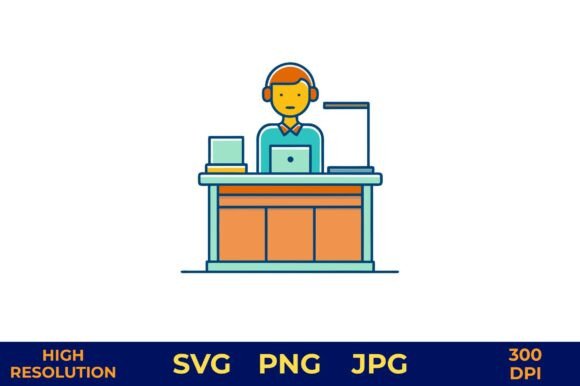
If you’ve ever scrolled through design marketplaces looking for a clean, friendly, and instantly recognizable visual of professional customer support—someone calm, capable, and ready to help—you’ve probably imagined exactly what Customer Service Agent at Desk delivers. It’s not just another clipart-style figure. This is a high-fidelity, colorful vector illustration of a customer service representative seated at a modern, vibrant desk, laptop open, headset on, fully engaged. Designed with intention—not decoration—it’s built to work where real people need it most: in communications that build trust, clarity, and connection.
Why This Illustration Fits Real Workflows (Not Just Stock Galleries)
Unlike generic office silhouettes or overly stylized avatars, Customer Service Agent at Desk strikes a practical balance: professional but approachable, detailed but scalable, warm but not cutesy. That matters when you’re designing something people actually interact with—like a small business’s “How We Help” page, a training module for new hires, or a welcome email series for SaaS customers.
Think about the last time you onboarded a client or explained your support process. Did you use text alone? Or did you wish you had a visual that quietly said, “We’re here—and we mean it”? That’s where this illustration earns its place. It doesn’t shout. It reassures. And because it comes in SVG, PNG, and JPG formats—with transparent backgrounds and crisp 4200×4200 px resolution at 300 dpi—it holds up whether you’re printing a 24" poster for your retail kiosk or dropping it into an Instagram Story carousel.
Where People Actually Use It (and Why It Works There)
Educators and trainers drop it into slide decks when teaching soft skills—like active listening or empathy in digital communication. A single frame of someone leaning in, headset on, eyes focused on their screen tells students more than bullet points ever could. One community college instructor told us she uses it in her customer service certification course to spark discussion: “What does this person’s posture say before they even speak?”
Small business owners use it on printed “Support Hours” signs taped beside front desks—or as part of branded PDF guides they email after purchase. A local florist added it to her “After-Order Care” printable kit, pairing the image with simple steps like “Need help with your bouquet? Text us!” It softened the tone without sacrificing professionalism.
Freelancers and agencies embed it in pitch decks—not as filler, but as visual proof of service philosophy. When proposing a client support overhaul, showing Customer Service Agent at Desk next to a workflow diagram makes abstract strategy feel human and actionable. No stock photo of a smiling stranger in a headset; just clear, consistent, ownable imagery.
Bloggers and content creators use it to break up long-form posts about remote work, UX writing, or building customer loyalty. Placed mid-article beside a tip like “Answer emails within two hours—not just for speed, but for continuity”—it adds quiet emphasis. Readers pause. They recognize the scene. It feels familiar, not forced.
What You Can Do With the Files (Beyond “Just Add to Design”)
The package includes three formats—SVG, PNG, and JPG—each serving different needs:
- SVG scales infinitely without pixelation, making it ideal for responsive websites, interactive dashboards, or editable branding kits. Change colors to match your palette in seconds—no redesign needed.
- PNG with transparent background drops cleanly into Canva, Adobe Express, or Figma projects. Perfect for social media banners, email headers, or digital workbooks where white space matters.
- JPG gives you maximum compatibility for print-on-demand services—think mugs, tote bags, or framed office art for your team’s break room. At 300 dpi and 4200 px square, it prints sharp even at large sizes.
And yes—it’s designed for real-world reuse. You’ll find it working quietly on wedding seating charts (“Our Guest Support Team” section), in photographer-branded client onboarding PDFs, on planner stickers for solopreneurs tracking support tickets, and even as subtle decor on bridal shower “Ask Me Anything” cards. It adapts because it’s grounded—not trendy.
Things to Keep in Mind Before You Download
This is a digital product. No physical item ships. You’ll get instant access to download links—no waiting, no shipping fees, no inventory limits. But that also means it’s up to you to check fit before use:
- Consider your brand voice. Does “friendly professionalism” align with how your audience experiences you? If your brand leans highly technical or minimalist, you may want to adjust colors or pair it with bolder typography to keep tone consistent.
- Check usage context. While licensed for commercial use—including merchandise and digital products—always verify platform-specific rules. For example, some print-on-demand sites require attribution for certain file types (though this one doesn’t).
- Test scalability early. Even though SVG handles resizing well, preview how the fine details—like laptop screen glow or headset mic placement—read at smaller sizes (e.g., 150×150 px for app icons). When in doubt, simplify layers in your editor instead of shrinking blindly.
Who Benefits Most—and How It Shows Up in Their Day
A freelance UX writer uses it in a client presentation to visualize a proposed “support journey map.” Instead of describing touchpoints, she shows the agent at desk receiving a chat notification, then shifts to a second version—same character, now holding a handwritten thank-you note from a customer. The visual thread makes the strategy unforgettable.
A homeschool co-op coordinator prints it on laminated “Tech Helper” badges for student volunteers. It signals role without jargon—and kids respond to the clarity, not the title.
A boutique hotel inserts it into a QR-coded guest guide. Scanning takes guests to a short video of their front desk team—but the still image builds recognition and warmth *before* the video starts.
In each case, Customer Service Agent at Desk isn’t decoration. It’s a bridge: between expectation and experience, instruction and intuition, service and sincerity.
Final Thought: It’s Not About the Image—It’s About the Signal
You don’t need more visuals. You need the right one—the one that says what words struggle to convey in tight spaces and busy contexts. The one that feels like it belongs, not just in your files, but in your workflow, your message, and your audience’s moment of need. That’s why so many creators come back to Customer Service Agent at Desk: not because it’s perfect, but because it’s purpose-built—for real use, real users, and real outcomes.